

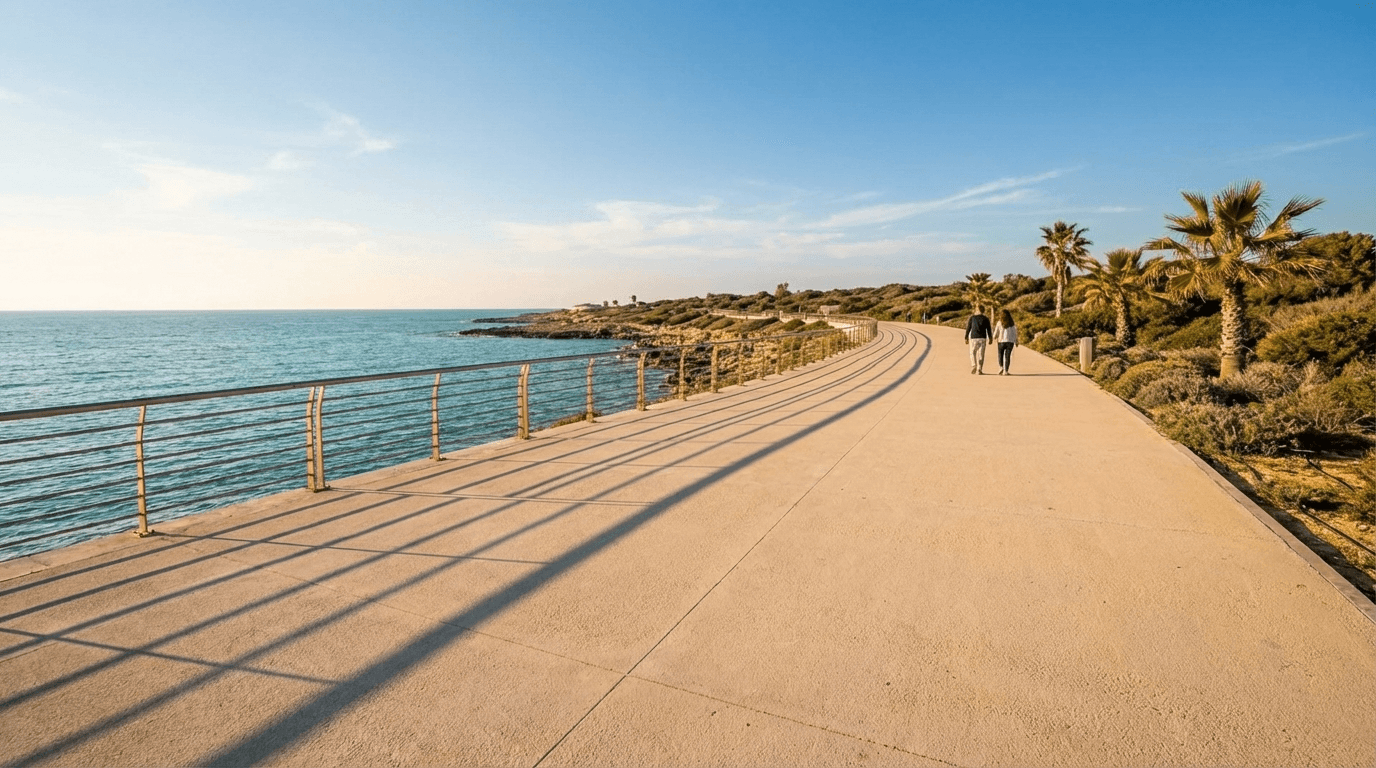
The Walk at a Glance
This is one of those walks that people talk about long after they have left Paphos. The route follows the coastal boardwalk — locally called the Broadwalk — from the medieval castle at Paphos Harbour all the way to the ancient Tombs of the Kings. It is flat, paved, and runs right along the Mediterranean. No hills, no scrambling, no navigation required.
We recommend it to every guest who stays with us. Many do it on their first evening.
Starting Point: The Medieval Castle
Begin at the harbour, at the base of the castle breakwater. If you are staying at Poseidon, you are already here — just walk towards the castle and turn right (north) along the waterfront.
The castle itself is worth a quick visit before you set off. Climb to the rooftop for a panoramic view of the route ahead — you can see the entire coastline stretching north, with the Tombs of the Kings visible in the distance on a clear day.
The Route: What You Will See
Section 1: Harbour to Archaeological Park (10 minutes)
The first stretch takes you past the harbour restaurants and along the edge of the Paphos Archaeological Park. To your left is the Mediterranean. To your right, behind a low fence, you can see the ancient ruins — the columns of the Odeon amphitheatre, the foundations of Roman villas, and the Paphos Lighthouse sitting on the hill above.
This section of the path is wide and busy in the early evening. Joggers, families, and other walkers share the boardwalk.
Section 2: Lighthouse Beach (15 minutes)
As you move past the Archaeological Park, the path runs alongside Lighthouse Beach (Faros Beach). This is a stretch of golden sand with clear water — one of the better beaches in central Paphos. If you are doing this walk in the morning, you might want to stop here for a swim on the way back.
The Paphos Lighthouse itself stands on the low hill to your right. It is not open to the public, but it makes an excellent landmark and a good subject for photographs, especially in the late afternoon light.
Section 3: The Hotel Strip (10 minutes)
The path continues north past some of Paphos's larger hotels — the Almyra, Annabelle, and Alexander the Great are all along this stretch. The boardwalk here is well maintained with planted borders. You will pass a few sculptures along the way — there is an informal art trail built into the promenade.
Look out for the Statue of the Little Fisherman, a small bronze figure that has become a local landmark. It is easy to miss if you are not looking for it.
Section 4: Approach to the Tombs (10 minutes)
The final section curves slightly inland as you approach the Tombs of the Kings area. The landscape opens up — fewer buildings, more scrubland, and a sense of approaching something ancient. The entrance to the tombs is well signposted from the path.
At the End: The Tombs of the Kings
The name is misleading — no kings were actually buried here. These are the tombs of Ptolemaic aristocrats and high officials, carved from solid rock in the 4th century BC. The name comes from the sheer scale and grandeur of the underground chambers.
What makes them remarkable is the architecture. Tomb No. 3 is the most impressive: an open atrium below ground level, surrounded by Doric columns, influenced by ancient Egyptian burial traditions. Standing in the centre of it, several metres below the surface, surrounded by 2,400-year-old stonework, is genuinely moving.
Practical Details
Tips for the Walk
Go in the late afternoon. The light is softer, the temperature is cooler, and you get the sunset on your return walk. In summer, midday is too hot for a 7 km round trip.
Bring water. There are a few cafes along the route, but they thin out in the second half. Carry a bottle, especially in summer.
One way by bus. If you prefer to walk only one direction, the E701 bus runs along the road parallel to the coast. You can walk to the Tombs and bus back, or vice versa.
Combine it with a swim. Lighthouse Beach, roughly at the halfway point, is a natural stop. Bring a towel if you want to break the walk with a dip.
Photography. The walk is good for photos at any time, but the golden hour stretch — around 5pm to 7pm in summer — is when the coastline and castle look their best.
Why We Love This Walk
There are flashier excursions in Paphos. You can take a boat to the Blue Lagoon or drive to the Akamas Peninsula. But this walk captures something essential about the place: ancient history, coastal beauty, and the simple pleasure of putting one foot in front of the other along the Mediterranean.
It costs nothing (beyond the 2.50 EUR at the Tombs). It requires no transport, no booking, no planning. And it starts from our front door.